


You’ve probably heard the buzz: verifiable credentials (VCs) are being called the future of identity. With backing from W3C, adoption by tech giants like Microsoft, Google and Apple and recent pilots across finance, education and government sectors around the world, the momentum is real.
But between decentralized frameworks, emerging standards and constant industry noise, it’s easy to feel like you’re missing the point.
If you’re leading customer identity, access security or digital onboarding initiatives, “verifiable credentials” might sound like just another trend to worry about.
Here’s the thing—they’re not. In fact, VCs are built to make identity simpler, more secure and far less repetitive.
Identity You Can Reuse (Finally)
Think of verifiable credentials as reliable, secure proof your users carry with them. Once someone proves who they are—whether to a bank, a government agency or your app—that proof becomes reusable. No more resubmitting documents or re-verifying what’s already been verified.
That means you can streamline sign-up and onboarding by verifying once and reusing credentials everywhere, while also delivering a smoother experience during high-risk actions like account recovery or step-up authentication, all without sacrificing trust or security.
What Is a Verifiable Credential?
As mentioned before, Verifiable Credentials are secure, digital representations of real-world identity documents like passports, driver’s licenses, diplomas or financial records. But unlike static scans or PDFs, VCs are cryptographically signed, tamper-resistant and instantly verifiable—and they’re supported by infrastructure built to securely carry them, such as Apple Wallet or dedicated digital ID apps.
Here’s the difference:
How Verifiable Credentials Work
Verifiable Credentials are built on an open and interoperable standard called the W3C Verifiable Credentials Data Model 2.0. This global specification defines how digital identity data should be issued, stored, shared and verified, no matter what platform, wallet or provider is involved.
Here’s how it works in practice:
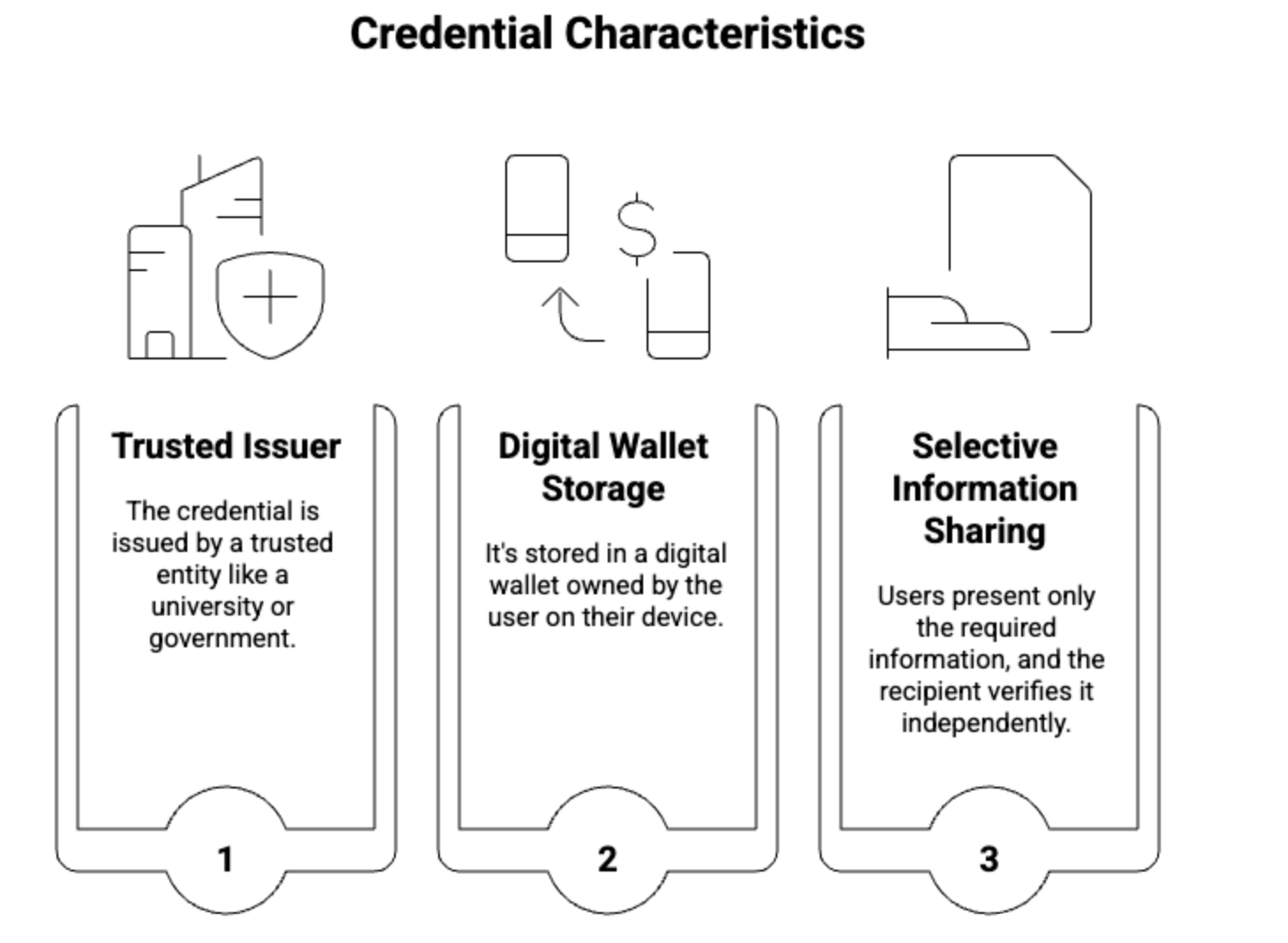
1. Issuance: A trusted issuer, like a government agency, financial institution or Transmit Security, verifies your identity and issues a credential. This credential is digitally signed using the issuer’s private key, making it tamper-proof.
2. Storage: The credential is stored in the user’s digital wallet or other dedicated app. The user maintains full control and no third party can access the credential without their explicit consent. For businesses, this reduces the burden of storing sensitive identity data, helping minimize compliance risk and potential data breaches.
3. Presentation: When a verifier requests proof (for example, to confirm the user is over 18), the user presents only the necessary information. They have the ability to choose what data to share and what to keep private. For customers, this results in a smoother, privacy-preserving user experience, especially during key interactions like onboarding, login or account recovery.
4. Verification: The verifier checks the credential’s digital signature to instantly confirm its authenticity and ensure it hasn’t been tampered with. There’s no need to contact the original issuer, which means faster decision-making, lower operational costs and a scalable way to build trust without adding friction.
Real-World Examples: The Value Delivered
Onboarding for Financial Services
A fintech company needs to onboard new users while meeting KYC requirements. Instead of slow, manual checks, it verifies users with an ID scan, selfie, liveness check and fraud detection. Once verified, the user receives a verifiable credential that proves their identity. For future sensitive transactions, they can simply present this credential—no need to repeat the process. The result? Faster validation, less friction and better fraud protection.
Trusted Step-Up Verification for Sensitive Actions
A user is performing a sensitive action such as approving a high-value purchase or changing critical account settings. The platform triggers a step-up verification request using a verifiable credential issued during the user’s original identity verification. With a single tap, the user presents the credential from their digital wallet. The system instantly verifies its authenticity without exposing any additional personal information.
For the business, this provides a high-assurance approval flow that reduces fraud and operational overhead. For the user, it delivers a seamless, secure verification experience.
Frictionless Onsite Verification
You book a car online and go through ID verification—license scan, selfie, done. A VC is issued confirming your identity. When you arrive at the rental counter, you simply present the credential. The system verifies you instantly. No documents, no waiting, no repeat verification.
Why Verifiable Credentials Matter
- Privacy & control: You share only what’s necessary and nothing more. VCs give individuals control over their identity data.
- Built-in trust: With cryptographic signatures, verifiers can instantly trust the credential knowing it came from a valid issuer and hasn’t been tampered with.
- Instant verification: Say goodbye to calling issuers, waiting on PDFs or manually checking documents. VCs reduce friction at every point of the customer journey.
- Universal use: From government IDs to workplace credentials and verified digital attributes, VCs support a wide range of use cases across industries and platforms.
It’s Time to Simplify Identity
Identity doesn’t have to be slow, painful or repetitive. Verifiable credentials offer a smarter, more secure foundation for proving who you are—once, and everywhere after that.
And if you’re building customer journeys where trust, speed and control matter? It’s worth a closer look.