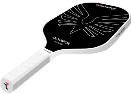


Transmit Security is serving up unbeatable protection – and custom pickleball paddles at RSA 2025. Book a meeting to grab yours and take your security game to the next level!
Glossary
Multi-tenancy in identity is an architecture where a single identity platform serves multiple distinct groups of users, called tenants, keeping each tenant’s users, data, and configuration logically isolated while sharing the underlying infrastructure. A tenant might be a business customer, a brand, a subsidiary, or a region.
Multi-tenancy matters most for B2B and platform businesses, where one provider must serve many customer organizations, each expecting its own users, branding, policies, and strict separation from the others.
The platform partitions identities by tenant so that each tenant’s users and administrators see and touch only their own space, even though they run on shared systems. Each tenant can have its own configuration: authentication methods, branding, access policies, and sometimes its own identity providers for federation. Strong isolation is the core requirement, since a leak between tenants would be a serious breach.
Multi-tenancy lets a business scale to many customer organizations efficiently without standing up separate infrastructure for each. For CIAM serving B2B, it is often essential: each business customer administers its own users (delegated administration), under its own policies, isolated from every other customer. The engineering challenge is delivering that isolation and per-tenant flexibility without fragmenting into unmanageable complexity.
What is a tenant in identity?
A distinct, isolated group of users (such as a business customer or brand) served by a shared identity platform.
Why is multi-tenancy important for B2B identity?
It lets one platform serve many customer organizations, each with its own users, policies, and isolation.
What is the main requirement of multi-tenancy?
Strong logical isolation between tenants, so one tenant can never access another’s users or data.
Related: B2B Identity Management · Delegated Administration · CIAM · User Management